
Grievance Management

Identify trends and connect related grievances with tags.

Assign tags to grievances and representation matters to quickly find related cases, identify recurring issues, and preserve organizational knowledge.

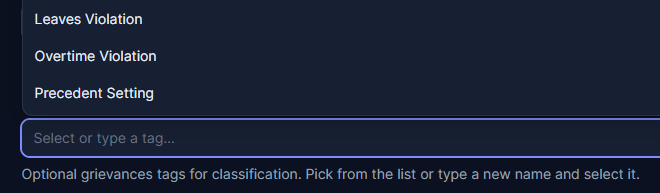
Adding a tag to a grievance

Important patterns are easy to miss.

When grievances are tracked only by employee name or grievance number, it becomes difficult to identify larger trends affecting your members. Representatives may unknowingly handle similar issues multiple times without realizing related grievances already exist.
Organize grievances beyond traditional categories.

Tags allow representatives to assign meaningful labels to grievances and matters. A grievance can have multiple tags, making it easier to group related issues regardless of department, workgroup, or filing date.

  • Assign multiple tags to a grievance
  • Create organization-specific tags
  • Search across all tagged matters
  • Identify recurring workplace issues
  • Support research and preparation
  • Build institutional knowledge

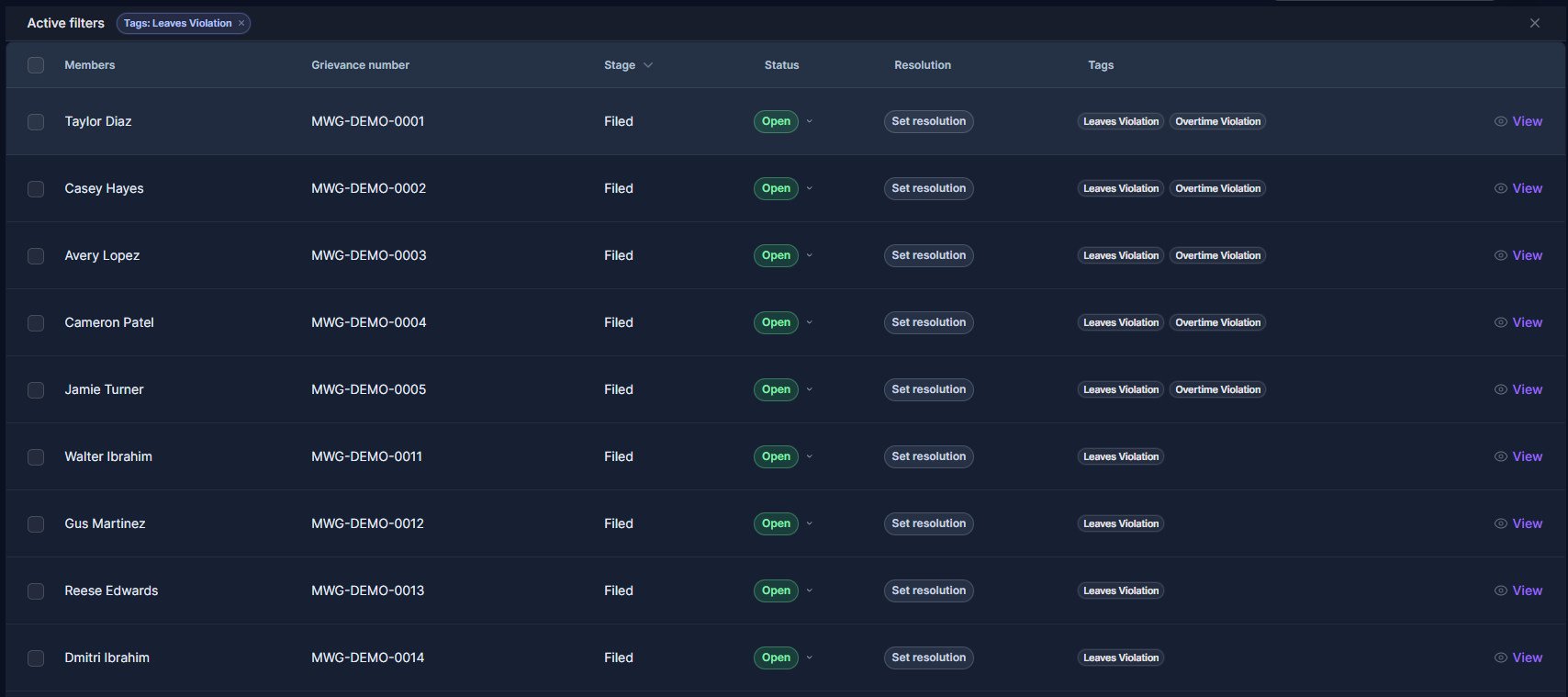
Find every grievance related to a specific issue.

Imagine a representative receives a new grievance involving attendance discipline. Instead of starting from scratch, they can search the Attendance tag and instantly review every related grievance previously handled by the organization.


This provides valuable context, including:

  • Prior resolutions
  • Similar fact patterns
  • Relevant meeting notes
  • Hearing outcomes
  • Historical decisions

View grievances by tag

Keep important cases from being forgotten.

Some grievances become important reference points for future representation work. By applying tags such as "Precedent Setting," "Contract Interpretation," or other organization-specific classifications, representatives can quickly locate historically significant matters years later.

  • Identify precedent-setting grievances
  • Preserve organizational knowledge
  • Support leadership transitions
  • Improve consistency across representatives
  • Reduce duplicated research